

Most millennials can recall teenage years spent locked in our rooms and blaring our favorite songs from oversized 6-CD players. We rocked out with air guitars (and real ones). Hair brushes doubled as microphones in a pinch. My husband hilariously refers to this golden era as “the old ways.” And he’s right.
Today, younger generations spend plenty of time in their rooms. Studies show that while they’re hooked on social media, they are unprecedentedly socially withdrawn from the real world. But their downtime is often spent not trying to hit the same high notes as their favorite singer while tuning out their parents as they yell from the living room, “Turn it down!” A lot of times, their eyes are glued to their screens while watching shortform videos, with music as a decorative touch added at the last step of the publishing process.
They get big ideas. They think, “All these kids are posting, so why shouldn’t I?” They get on TikTok or Instagram and start making their own content. Professional Instagrammers (I don’t know what else to call them) talk about two kinds of content that gets views, or what I like to call, “attention.” One is professional-style content. Think brand-centric photoshoots by Ralph Lauren. Or hype videos sports teams drip out during playoff runs. The other kind is raw, unfiltered content. Since these users often lack the technology needed to produce professional videos, and being swept up in social media culture and wanting a piece of its currency (attention), they choose the latter. They film themselves having meltdowns. Videos become therapy sessions. They record monologues talking about perfectly normal behavior that somehow gives them a diagnosis (a self-diagnosis of course) that now makes them feel special—oftentimes it’s “autism.” But the point is they want you to know they’re very, very traumatized.
(There are outliers in every generation. But it doesn’t take long to find this type of person on the internet.)
A ‘Hold My Beer’ Moment in Music History
My generation had our fair share of negative and powerful emotions. That’s why we were in our rooms with our volume knobs turned up loud enough to drown out the noise in our heads. A lot of parents of millennials listened to everything from The Beatles to Jimi Hendrix in their bedrooms and dorm rooms. Then, Gen X, the generational older sibling to us millennials, came along and pulled a “Hold my beer” moment with Baby Boomers. They upped the musical ante with the advent of the grunge movement in the early 1990s. And suddenly, almost every teenager’s room was christened with the sounds of grunge’s band of holy angels, Nirvana.
The screams and distorted guitars emanating from bedroom speakers troubled the elders and the townspeople. After Nirvana’s breakthrough single, “Smells Like Teen Spirit,” dropped, parents called priests and politicians lectured (once again) about “the Devil’s music.” The subgenre being fresh on the heels of 1980s Satanic Panic didn’t help. There was concern that this type of rock music, and other forms including hard rock, heavy metal, and the emo sub-genre of the early 2000s, would negatively affect the youth. Many adults worried that kids and teens who were listening to grunge and rock would exhibit many of the behaviors young generations now exhibit during their meltdowns that somehow take place in front of an ideal backdrop and are timed perfectly to the hitting of the Record button. I’d really like to know how they don’t produce snot bubbles during their sobfests. That’s a super power I’d like to master. But I digress.
(Back to the show, folks…)
Underrated Process of Human Order
Of course, Nirvana didn’t cause Gen X, or millennials, to go insane. It was quite the opposite actually. It turns out, the wails and whines of a flannel-and-Converse-clad Kurt Cobain acted much like the chemicals used to fog bees. Because of grunge music, those high-octane feelings of youth could be channeled into an outlet containing an equal amount of energy and force, and this transmission turned the hunger pangs of emotionalism, brought on by something as painful as a breakup or as inconsequential as a bad hair day, into an appetite for catharsis.
Catharsis is an underrated process of human order. Today, according to Brittanica, it is described as “the purification or purging of the emotions (especially pity and fear) primarily through art.” And this process, historically brought about by the Greek’s love for tragic plays, was first described by Aristotle in his Poetics:
“Tragedy, then, is an imitation of an action that is serious, complete, and of a certain magnitude; in language embellished with each kind of artistic ornament, the several kinds being found in separate parts of the play; in the form of action, not of narrative; through pity and fear effecting the proper purgation of these emotions.”
Grunge, heavy metal, emo, punk—these were all cathartic channels for Gen-Xers and millennials as they grew up. The music of the 1990s-early 2000s rock renaissance as a whole had the makings of tragedy: disorder, violence, enemies and heroes, lessons learned, and plenty of comedy and occasional irony. Like Oedipus Rex or Prometheus Bound, the afflictions and misadventures in songs like “Lithium” by Nirvana and “Teenagers” by My Chemical Romance (a staple band of the emo era), give rise to the same type of state Aristotle described. Gen X and millennials alike have memories of stomping off to their rooms after being given a perfectly reasonable “no” by their parents and having to cool off for about 20 minutes while blaring Soundgarden or Pearl Jam.
Catharsis is also a physiological process studied in medicine. A 2015 Frontiers in Human Neuroscience study found that “extreme” music, in this case heavy metal, had a positive effect on those who listened to it:
“Researchers found that the effects of listening to the so-called ‘extreme’ music were similar to the effects of ten minutes of silence, suggesting that both can be calming. Many participants reported feeling inspired after listening to music, and researchers noted that participants were less irritable and aggressive after hearing the music of their choice.”
The study concluded that “rather than being a catalyst for negative or aggressive emotions, angry music can help listeners process their feelings and as a result lead to greater well-being.”
Nonprofit Healthcare Network Inspira Health shared, “One of heavy metal’s greatest gifts is catharsis.” High-powered guitar riffs and unbridled vocals are not catalysts but conduits for emotions like pity, fear, anger, and grief. Therapist Robert Whitekettle explained that, “Neuroscientists suggest this process engages the brain’s emotional centers, called the limbic system, helping to regulate intense feelings and leaving listeners feeling energized rather than agitated.”
Being Seen and Feeling Seen
Younger generations have lost precious bulwarks against inner-turmoil, and art is unfortunately still a surprisingly overlooked outlet for emotional regulation. They’ll never know the thrill of a traditional album release day; an album they’ve been waiting to pick up since the last one came out years prior. The decorative place music is cornered into online inspires no headlining performance in front of a mirror (younger generations’ choreographed dancing is fun, but doesn’t offer much time for the self-reflection that catharsis does). Friends no longer get together to listen to entire albums while poring over liner notes. And if this is happening, it’s too scarce to constitute a pattern common enough to recognize as culture.
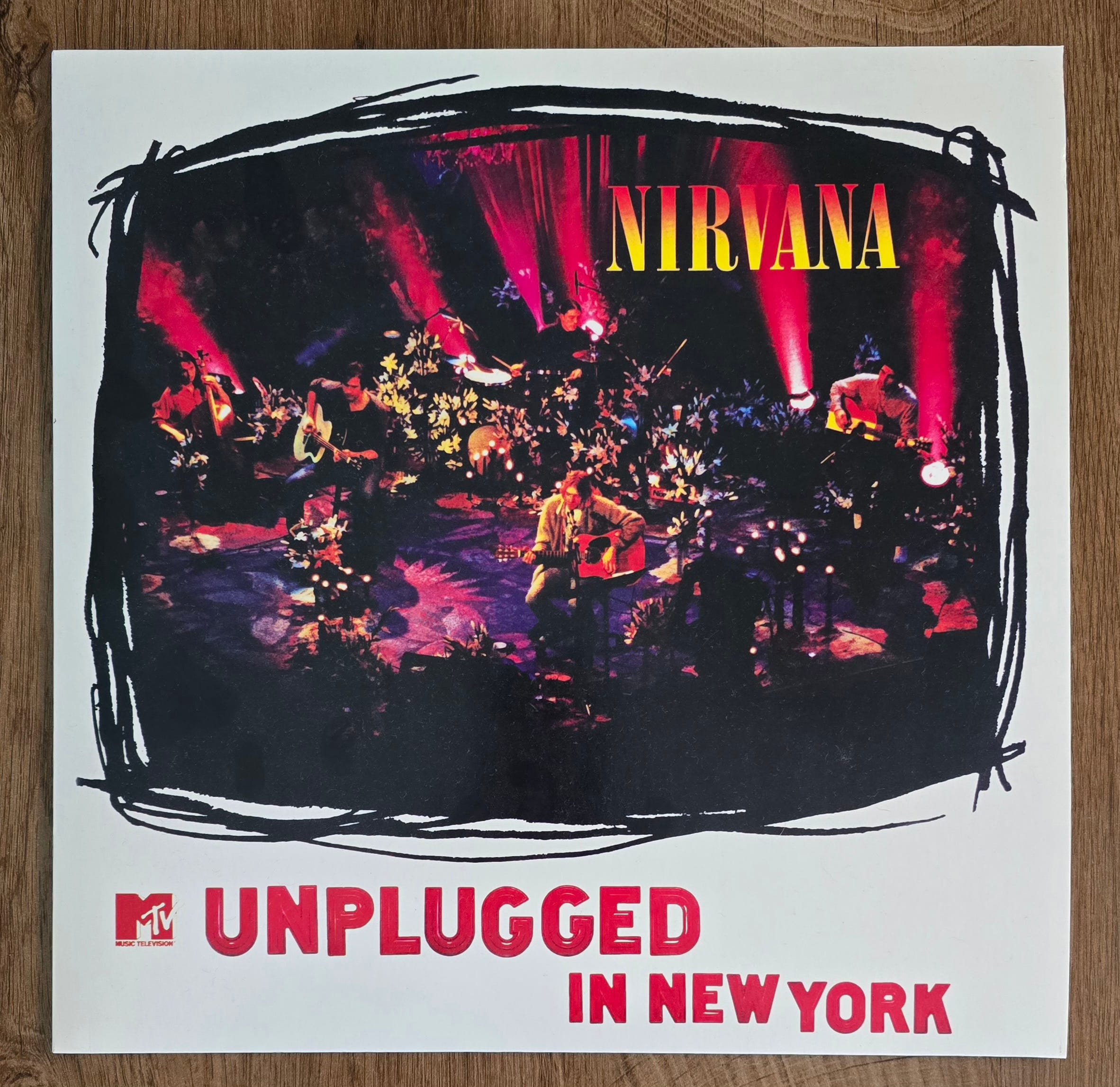
Because of this, we’ve transitioned, generationally, to people who need to be seen, instead of needing to feel seen. One is shallow and cheapens emotion. The other requires depth and deepens emotion. The need to be seen requires an ultimately meaningless exchange. An outburst or a breakdown for the tap of a Like button, or “Yas, Queen!” or “Same!” comment. But feeling seen is a totally different ballgame. When a listener feels seen by an artist—and many Gen-Xers and millennials felt seen for the first time thanks to Cobain—it means the listener has some idea of who he or she is on the inside, and the music validates that on the outside. This once created a deep connection between teens and music—one that remains unbroken today (I still enjoy listening to Nirvana’s pivotal MTV Unplugged in New York record).
So, maybe there’s hope for these youngsters yet. A teen who can’t stop making sobby TikToks doesn’t need an intervention. All our future FICA family member needs is a little bit of our old ways.
I admire your penchant for picking a single word from vocabulary and writing a story around it (I do the same thing).
Being a former seventies radical my exposure to grunge was limited to my younger siblings and my nephews while I tried playing to their errant guitar-tunings (we're The Hepcats).
Lastly, I'm seeing a refreshing return to straight talk, and am taking mine to the tech industrial complex. Maybe start a trend among the intelligentsia. Speaking directly is a survival tactic.
Although I was born at the tail end of the Baby Boom, I've always liked 90s music: "Smells Like Teen Spirit," "You Oughta Know," Fiona Apple, etc. Things got boring for me after the turn of the millennium. Right now, I've regressed to my childhood and mostly listen to the Beatles.